
You may also enjoy:
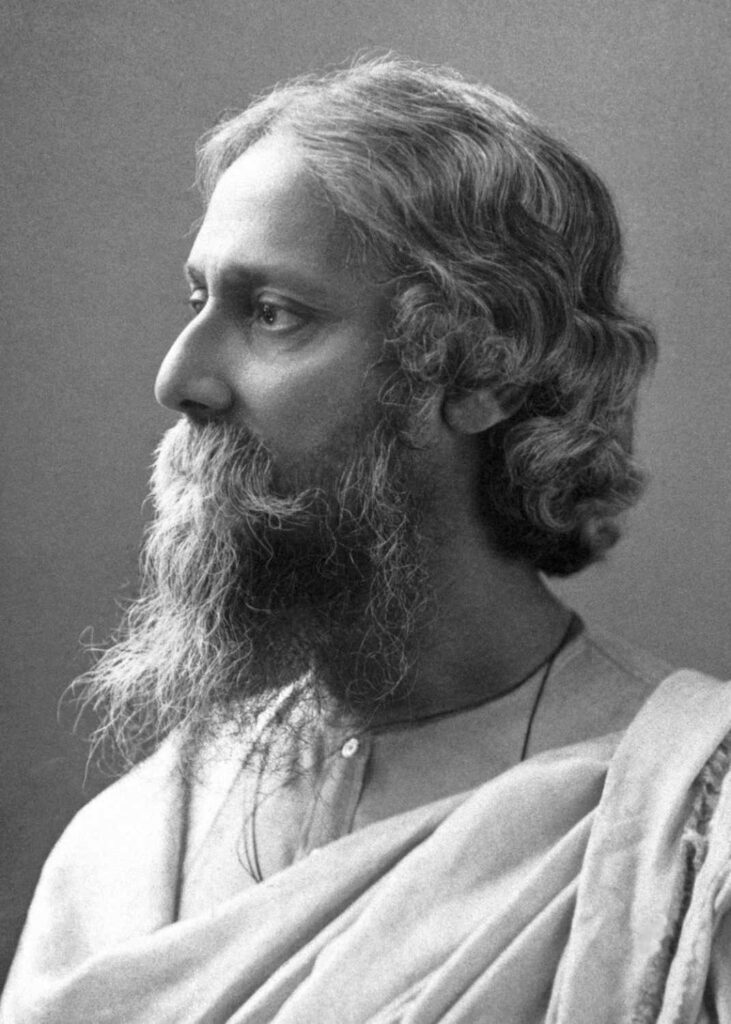
Rabindranath Tagore (7 May 1861 – 7 August 1941) was a Bengali poet, philosopher, composer, and painter whose work reshaped modern world literature. The first non-European Nobel Prize winner in Literature, Tagore is known for poetry that moves between devotion, longing, nature, mortality, and spiritual wonder. His self-translated English poems, especially from Gitanjali, carry a quiet intimacy that continues to resonate across cultures.
Born: 7 May 1861, Jorasanko, Calcutta, Bengal Presidency, British India
Died: 7 August 1941, Calcutta, Bengal, British India
Nationality: Indian
Main themes:
• devotion and spiritual longing
• mortality and impermanence
• love and separation
• nature and transcendence
• freedom and selfhood
Why Read Rabindranath Tagore
Tagore’s poetry often feels like a conversation between the soul and the infinite. His work is deeply rooted in Bengali literary traditions while remaining strikingly universal, blending prayer, philosophy, and emotional vulnerability into poems that feel both ancient and immediate. For readers drawn to reflective, spiritual, or deeply human poetry, Tagore offers a voice of remarkable clarity and tenderness.
—
“Where the Mind is Without Fear”
One of Tagore’s most enduring poems, imagining freedom as both political and spiritual.
Where the mind is without fear and the head is held high;
Where knowledge is free;
Where the world has not been broken up into fragments
By narrow domestic walls;
Where words come out from the depth of truth;
Where tireless striving stretches its arms towards perfection;
Where the clear stream of reason has not lost its way
Into the dreary desert sand of dead habit;
Where the mind is led forward by thee
Into ever-widening thought and action—
Into that heaven of freedom, my Father, let my country awake.
—
“Leave This Chanting and Singing”
A striking rejection of empty ritual in favor of finding the divine in ordinary labor.
Leave this chanting and singing and telling of beads!
Whom dost thou worship in this lonely dark corner of a temple with doors all shut?
Open thine eyes and see thy God is not before thee!
He is there where the tiller is tilling the hard ground
and where the pathmaker is breaking stones.
He is with them in sun and in shower,
and his garment is covered with dust.
Put off thy holy mantle and even like him come down on the dusty soil!
—
“The Sleep that Flits on Baby’s Eyes” (excerpt)
A gentler, dreamlike poem showing Tagore’s tenderness and musical softness.
The sleep that flits on baby’s eyes—does anybody know from where it comes?
Yes, there is a rumour that it has its dwelling
where, in the fairy village among shadows of the forest dimly lit with glow-worms,
there hang two shy buds of enchantment.
From there it comes to kiss baby’s eyes.
—
“On the Seashore” (excerpt)
A luminous meditation on childhood, imagination, and the edge between worlds.
On the seashore of endless worlds children meet.
The infinite sky is motionless overhead
and the restless water is boisterous.
On the seashore of endless worlds
the children meet with shouts and dances.
They build their houses with sand
and they play with empty shells.
With withered leaves they weave their boats
and smilingly float them on the vast deep.
Children have their play on the seashore of worlds.
—
“The Same Stream of Life” (excerpt)
One of Tagore’s most beautiful expressions of shared existence and universal connection.
The same stream of life that runs through my veins night and day
runs through the world and dances in rhythmic measures.
It is the same life that shoots in joy through the dust of the earth
in numberless blades of grass
and breaks into tumultuous waves of leaves and flowers.
It is the same life that is rocked in the ocean-cradle of birth and of death,
in ebb and in flow.
I feel my limbs are made glorious by the touch of this world of life.
—
“Death, Thy Servant, is at My Door” (excerpt)
A calm, intimate confrontation with mortality, written with unusual peace.
Death, thy servant, is at my door.
He has crossed the unknown sea and brought thy call to my home.
The night is dark and my heart is fearful—
yet I will take up the lamp, open my gates and bow to him my welcome.
It is thy messenger who stands at my door.
—
“Light, My Light” (excerpt)
A radiant celebration of beauty, joy, and the overwhelming presence of the world.
Light, my light, the world-filling light,
the eye-kissing light,
heart-sweetening light!
Ah, the light dances, my darling, at the centre of my life;
the light strikes, my darling, the chords of my love;
the sky opens, the wind runs wild,
laughter passes over the earth.
—
How to Start Reading Rabindranath Tagore
If you are new to Tagore, begin with Where the Mind is Without Fear for his clearest and most widely loved work.
For spiritual and philosophical poems, explore Leave This Chanting and Singing and The Same Stream of Life.
If you prefer softer, more intimate poems, start with The Sleep that Flits on Baby’s Eyes or On the Seashore.
For readers interested in mortality and acceptance, Death, Thy Servant, is at My Door offers one of his most moving meditations.
If you enjoy lyrical celebration and sensory richness, try Light, My Light.
Final Thoughts
Rabindranath Tagore’s poetry moves with unusual ease between the earthly and the eternal. Whether writing of freedom, childhood, labor, death, or divine longing, he returns again and again to the idea that human life is deeply connected—to nature, to one another, and to something larger than ourselves. His poems remain enduring not because they offer certainty, but because they make room for wonder.
You might enjoy: