
You may also enjoy:
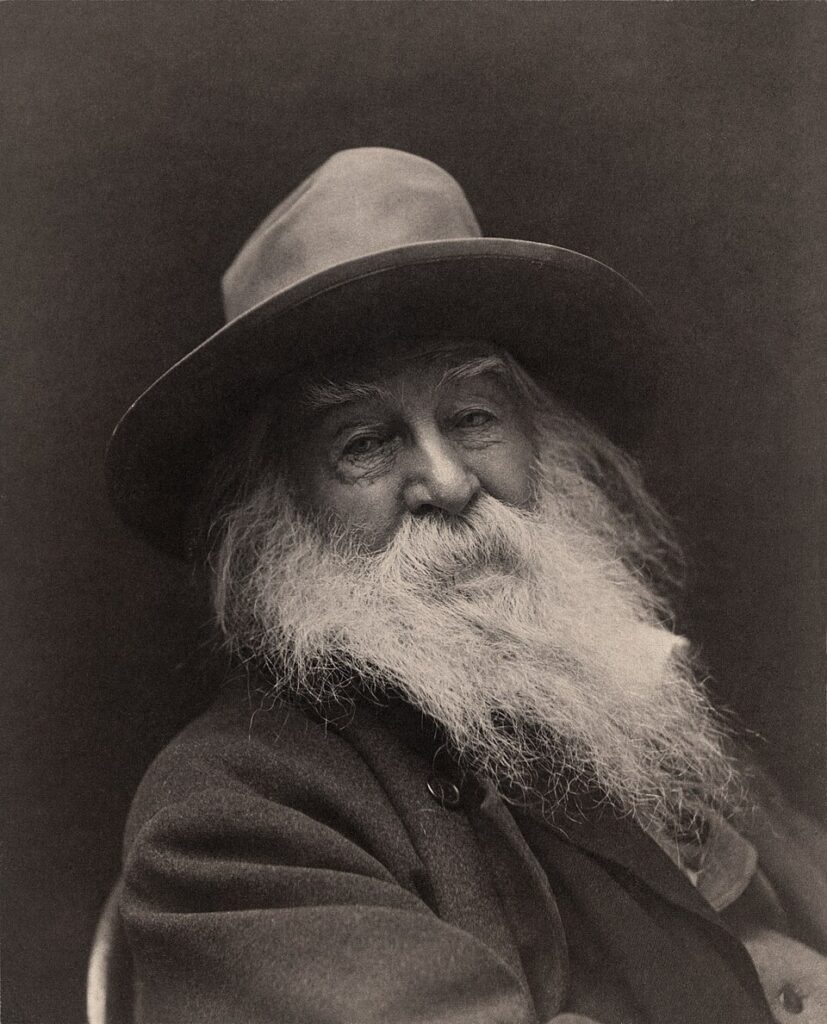
Walt Whitman (31 May 1819 – 26 March 1892) was an American poet, essayist, and journalist whose groundbreaking free verse helped redefine modern poetry. Often called the “father of free verse,” Whitman celebrated individuality, democracy, the body, nature, and the spiritual unity of all life. His work is known for its expansive voice, emotional openness, and deep belief in the sacredness of ordinary human experience.
Born: 31 May 1819, West Hills, New York, United States
Died: 26 March 1892, Camden, New Jersey, United States
Nationality: American
Main themes:
• Identity and selfhood
• Democracy and equality
• The body and sensuality
• Nature and the soul
• Death and immortality
• Human connection and shared experience
Why Read Walt Whitman
Walt Whitman’s poetry remains powerful for its freedom, energy, and emotional generosity. His poems celebrate life in all its forms, often blurring the lines between self and world, body and spirit, the individual and the collective.
“Song of Myself” (excerpt)
Whitman’s most famous poem, celebrating selfhood, individuality, and the shared human experience.
I celebrate myself, and sing myself,
And what I assume you shall assume,
For every atom belonging to me as good belongs to you.
I loafe and invite my soul,
I lean and loafe at my ease observing a spear of summer grass.
Stop this day and night with me and you shall possess the origin of all poems,
You shall possess the good of the earth and sun,
There are millions of suns left.
You shall no longer take things at second or third hand,
You shall listen to all sides and filter them from your self.
—
“O Captain! My Captain!”
One of Whitman’s most famous poems, written in mourning after Abraham Lincoln’s assassination.
O Captain! my Captain! our fearful trip is done,
The ship has weather’d every rack, the prize we sought is won,
The port is near, the bells I hear, the people all exulting,
While follow eyes the steady keel, the vessel grim and daring:
But O heart! heart! heart!
O the bleeding drops of red,
Where on the deck my Captain lies,
Fallen cold and dead.
—
“O Me! O Life!”
A brief but profound reflection on self-doubt, purpose, and what it means to contribute to life.
Oh me! Oh life! of the questions of these recurring,
Of the endless trains of the faithless,
Of myself forever reproaching myself,
The question, O me! so sad, recurring—
What good amid these, O me, O life?
Answer.
That you are here—that life exists and identity,
That the powerful play goes on, and you may contribute a verse.
—
“There Was a Child Went Forth” (excerpt)
A powerful meditation on childhood, family, and how identity is shaped by experience.
There was a child went forth every day,
And the first object he look’d upon, that object he became,
And that object became part of him for the day
or a certain part of the day,
or for many years or stretching cycles of years.
And the family usages, the language, the company, the furniture—
all became part of him.
—
“I Hear America Singing”
A joyful celebration of labor, individuality, and the many voices that make up a nation.
I hear America singing, the varied carols I hear,
Those of mechanics, each one singing his as it should be blithe and strong,
The carpenter singing his as he measures his plank or beam,
The mason singing his as he makes ready for work,
The boatman singing what belongs to him in his boat,
The shoemaker singing as he sits on his bench,
Each singing what belongs to him and to none else.
—
“When I Heard the Learn’d Astronomer”
A famous poem contrasting intellectual knowledge with direct personal experience.
When I heard the learn’d astronomer,
When the proofs, the figures, were ranged in columns before me,
When I was shown the charts and diagrams, to add, divide, and measure them,
When I sitting heard the astronomer where he lectured with much applause in the lecture-room,
How soon unaccountable I became tired and sick,
Till rising and gliding out I wander’d off by myself,
In the mystical moist night-air, and from time to time,
Look’d up in perfect silence at the stars.
—
“Crossing Brooklyn Ferry” (excerpt)
A moving poem about time, connection, and the invisible bonds between people across generations.
Flood-tide below me! I see you face to face!
Clouds of the west—sun there half an hour high—I see you also face to face.
Crowds of men and women attired in the usual costumes,
how curious you are to me!
What is it then between us?
What is the count of the scores or hundreds of years between us?
Whatever it is, it avails not—distance avails not, and place avails not.
How to Start Reading Walt Whitman
For identity and selfhood, begin with “Song of Myself.”
For grief and historical reflection, read “O Captain! My Captain!”
For purpose and existential reflection, start with “O Me! O Life!”
For childhood and formation of identity, explore “There Was a Child Went Forth.”
For Whitman’s celebration of democracy and human connection, read “I Hear America Singing.”
Final Thoughts
Walt Whitman’s poetry endures because it embraces life in its fullest form—messy, joyful, painful, and connected. His work invites readers to see themselves as part of something larger, and to find meaning in simply being alive.
You might enjoy: