
You may also enjoy:
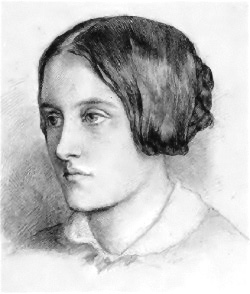
Christina Rossetti (5 December 1830 – 29 December 1894) was an English poet and one of the most important literary voices of the Victorian era. Known for her lyrical intensity, emotional restraint, and rich symbolism, Rossetti wrote about love, death, temptation, faith, longing, and sacrifice. Her poetry often blends beauty with sorrow, creating work that feels both intimate and haunting.
Born: 5 December 1830, London, England
Died: 29 December 1894, London, England
Nationality: English
Main themes:
• Love and longing
• Death and remembrance
• Faith and salvation
• Temptation and desire
• Sisterhood and sacrifice
• Nature and symbolism
Why Read Christina Rossetti
Christina Rossetti’s poetry remains beloved for its emotional precision, musical language, and haunting imagery. Her work often explores desire, loss, and spiritual struggle, balancing tenderness with darkness in ways that continue to resonate.
“Goblin Market” (excerpt)
Rossetti’s most famous and complex poem, blending temptation, desire, and sisterly devotion into one of Victorian poetry’s strangest masterpieces.
Morning and evening
Maids heard the goblins cry:
“Come buy our orchard fruits,
Come buy, come buy:
Apples and quinces,
Lemons and oranges,
Plump unpeck’d cherries,
Melons and raspberries,
Bloom-down-cheek’d peaches,
Swart-headed mulberries,
Wild free-born cranberries,
Crab-apples, dewberries,
Pine-apples, blackberries,
Apricots, strawberries—
Come buy, come buy.”
—
“Remember”
One of Rossetti’s most famous love poems, reflecting on memory, parting, and grief.
Remember me when I am gone away,
Gone far away into the silent land;
When you can no more hold me by the hand,
Nor I half turn to go yet turning stay.
Remember me when no more day by day
You tell me of our future that you plann’d:
Only remember me; you understand
It will be late to counsel then or pray.
Yet if you should forget me for a while
And afterwards remember, do not grieve:
For if the darkness and corruption leave
A vestige of the thoughts that once I had,
Better by far you should forget and smile
Than that you should remember and be sad.
—
“Song (When I am dead, my dearest)”
A gentle and heartbreaking meditation on death and release.
When I am dead, my dearest,
Sing no sad songs for me;
Plant thou no roses at my head,
Nor shady cypress tree:
Be the green grass above me
With showers and dewdrops wet;
And if thou wilt, remember,
And if thou wilt, forget.
I shall not see the shadows,
I shall not feel the rain;
I shall not hear the nightingale
Sing on, as if in pain:
And dreaming through the twilight
That doth not rise nor set,
Haply I may remember,
And haply may forget.
—
“A Birthday”
A joyful and radiant poem celebrating love, wonder, and emotional fullness.
My heart is like a singing bird
Whose nest is in a watered shoot;
My heart is like an apple-tree
Whose boughs are bent with thickset fruit;
My heart is like a rainbow shell
That paddles in a halcyon sea;
My heart is gladder than all these
Because my love is come to me.
Raise me a dais of silk and down;
Hang it with vair and purple dyes;
Carve it in doves and pomegranates,
And peacocks with a hundred eyes;
Work it in gold and silver grapes,
In leaves and silver fleurs-de-lys;
Because the birthday of my life
Is come, my love is come to me.
—
“Echo”
A dreamlike poem of longing, memory, and the ache of absence.
Come to me in the silence of the night;
Come in the speaking silence of a dream;
Come with soft rounded cheeks and eyes as bright
As sunlight on a stream;
Come back in tears,
O memory, hope, love of finished years.
Oh dream how sweet, too sweet, too bitter sweet,
Whose wakening should have been in Paradise,
Where souls brimful of love abide and meet;
Where thirsting longing eyes
Watch the slow door
That opening, letting in, lets out no more.
—
“Up-Hill”
A philosophical and spiritual poem about life’s journey and the promise of rest.
Does the road wind up-hill all the way?
Yes, to the very end.
Will the day’s journey take the whole long day?
From morn to night, my friend.
But is there for the night a resting-place?
A roof for when the slow dark hours begin.
May not the darkness hide it from my face?
You cannot miss that inn.
Shall I meet other wayfarers at night?
Those who have gone before.
Then must I knock, or call when just in sight?
They will not keep you standing at that door.
—
“In the Bleak Midwinter”
One of Rossetti’s most beloved devotional poems, reflecting humility, wonder, and divine love.
In the bleak midwinter, frosty wind made moan,
Earth stood hard as iron, water like a stone;
Snow had fallen, snow on snow,
Snow on snow,
In the bleak midwinter, long ago.
Our God, Heaven cannot hold Him,
Nor earth sustain;
Heaven and earth shall flee away
When He comes to reign.
In the bleak midwinter
A stable-place sufficed
The Lord God Almighty,
Jesus Christ.
What can I give Him,
Poor as I am?
If I were a shepherd
I would bring a lamb;
If I were a Wise Man
I would do my part;
Yet what I can I give Him:
Give my heart.
How to Start Reading Christina Rossetti
For temptation, desire, and sisterhood, begin with “Goblin Market.”
For love, loss, and remembrance, read “Remember.”
For reflections on death and letting go, start with “Song (When I am dead, my dearest).”
For Rossetti’s joyful and celebratory side, explore “A Birthday.”
For spiritual and philosophical themes, begin with “Up-Hill” or “In the Bleak Midwinter.”
Final Thoughts
Christina Rossetti’s poetry endures because it captures longing, faith, love, and sorrow with remarkable clarity and grace. Her work moves easily between earthly desire and spiritual reflection, making her one of the most distinctive voices in Victorian poetry.
You might enjoy: